
What is a semiquantitative ovulation test and why does the number actually matter?
Because knowing your number changes everything.
TL;DR (too long; didn’t read)
A semiquantitative ovulation test shows you a number that reflects your LH (luteinising hormone) level. After testing, you match your Test Line colour to the Test Reader Colour Card, where each colour corresponds to an LH numerical value, and record that number on your LH Fluctuation Curve Chart. No positive or negative. An actual number you can plot across your cycle, so you can see your hormone rising and falling, get a clearer picture of when ovulation is approaching, whether your surge was strong, and how your cycle looks month to month.
Most ovulation tests give you a line. This one gives you a number.
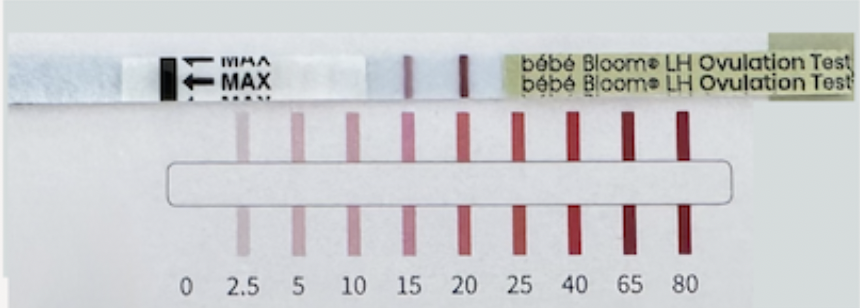
The Test Reader Colour Card shows nine colour gradations from light pink to deep red. After testing, you match your Test Line to the closest colour on the card. That colour corresponds to your LH numerical value, which you then record on your LH Fluctuation Curve Chart.
If you've used a standard ovulation strip before, you know the drill: two lines means positive, one line means negative. You're looking for that second line to be as dark as, or darker than, the control line. It works. But it tells you surprisingly little.
A positive result tells you your LH has crossed a threshold. It doesn't tell you how high it went, whether it's on its way up or already coming down, or whether your surge is typical for you. For women with irregular cycles, PCOS, or a history of unexplained results, this kind of binary answer can leave a lot of questions unanswered.
A semiquantitative ovulation test changes that. Instead of a positive or negative, you get a number: an LH numerical value you can track across your cycle, day by day. You match your Test Line colour to the Test Reader Colour Card, where each colour corresponds to an LH numerical value, and record that number on your LH Fluctuation Curve Chart.
So what does 'semiquantitative' actually mean?
Quantitative means measured. A fully quantitative test, like a blood test at a pathology lab, gives you a precise hormone concentration in mIU/mL.
Semiquantitative sits between that and a simple positive/negative strip. It gives you a meaningful numerical readout across a defined range, enough to track your LH trend accurately, without requiring a laboratory setting.
In practical terms: you still use a urine sample at home, but instead of reading a line intensity, you match your result to a colour-graded scale that maps to a number. That number represents where your LH sits right now.
How the bébé bloom test works
The bébé bloom Ovulation Test measures LH in your urine across a range of 0–80 mIU/mL, well above the threshold most standard tests are designed to detect.
After testing, you match the colour of your Test Line to the Test Reader Colour Card that comes with your kit. Each colour on the card corresponds to an LH value. You then record that number on your LH Fluctuation Curve Chart, a simple graph that shows your LH pattern across your cycle.
What you end up with isn't just a positive or negative. It's a curve. You can see your LH rising in the days before ovulation, peaking, and falling back down. The same pattern a fertility clinic would track, at home.
A more accurate read, by design
Standard ovulation strips ask you to judge whether a line is darker than another line. That judgement is subjective, and on low-contrast results it can be genuinely difficult to call. The bébé bloom test removes that ambiguity. You match your Test Line to a colour on the Test Reader Colour Card and record the corresponding numerical value. The result is objective and repeatable, with no line-squinting required.
The bébé bloom Ovulation Test is also TGA-registered (ARTG 351757), meaning it has been assessed against Australian regulatory standards for safety, quality, and performance as a therapeutic device.
Why does seeing the number actually matter?
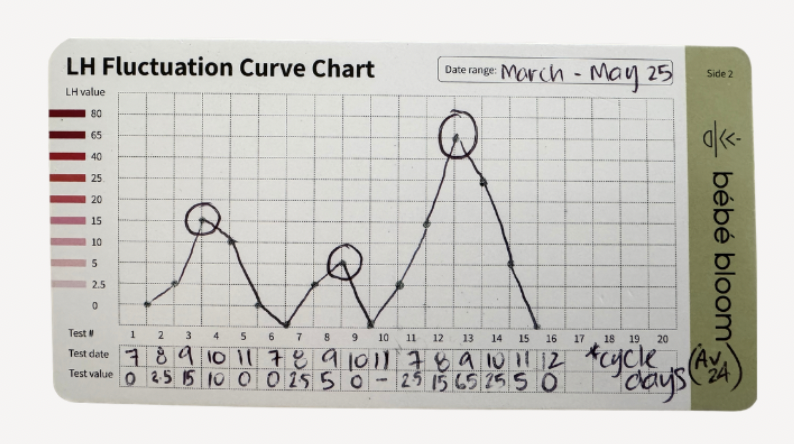
Three months of LH tracking on the bébé bloom LH Fluctuation Curve Chart. Each data point is a numerical value matched from the Test Reader Colour Card and plotted by test date. You can see the LH surge building, peaking, and falling back down across each cycle, including one cycle with a peak of 65 mIU/mL. This is the kind of pattern a standard positive/negative strip cannot show you.
1. You can catch your surge earlier
Standard strips only flag a positive once LH crosses a set threshold, often 25 mIU/mL or higher. If your LH peaks at 30 and drops quickly, you might only get one positive day (or miss it entirely if you don't test at the right time).
When you can see your number rising (8, 12, 18, 25), you know your surge is coming before it peaks. That gives you more lead time to act.
2. You know if your surge was strong
LH surges vary significantly between women. Some peak at 25 mIU/mL. Others peak at 60 or higher. A standard strip can't tell you which one you are. Knowing your peak LH over a few cycles helps you understand what 'normal' looks like for your body.
3. You can see patterns across cycles
When you're recording a number each day, your LH Fluctuation Curve Chart becomes a reference point. If your peak shifts, if your surge is shorter this month, if something looks different, you'll notice. That kind of longitudinal tracking is hard to do with a line.
4. It can support a broader conversation with your health practitioner
If you have irregular cycles or have been told you may have PCOS, ovulation tracking can feel confusing. LH levels and surge patterns vary significantly between women, and a positive/negative strip gives you limited information to work with.
Tracking your LH numerical values across a cycle and bringing that chart to an appointment with your GP, naturopath, or fertility specialist gives them more to work with too. Whether or not tracking is the right approach for your situation is a conversation worth having with your practitioner.
How is this different from a digital ovulation test?
Digital tests (the kind with a smiley face or a digital 'High'/'Peak' readout) are still qualitative. They just display the result differently. The underlying strip is still comparing your LH to a preset threshold. You're not seeing a number; you're seeing the device's interpretation of whether you crossed the threshold.
A semiquantitative test gives you the actual value. You're reading the data, not a summary of it.
Is it TGA-registered?
Yes. The bébé bloom Ovulation Test is registered on the Australian Register of Therapeutic Goods (ARTG 351757). That means it's been assessed for safety, quality, and performance, and meets the regulatory requirements for a therapeutic device sold in Australia.
Most ovulation tests sold in Australia are not TGA-registered. They are sold as general wellness products, not as regulated therapeutic devices.
Who is a semiquantitative test best suited to?
A semiquantitative ovulation test is worth considering if:
You've been trying to conceive for a few months and want more detail than a positive/negative result
You have irregular cycles or PCOS and standard strips have given you confusing or inconsistent results
You want to understand your cycle better before starting any kind of fertility treatment or investigation
You're working with a health practitioner and want data you can actually bring to an appointment
You've simply found that line-reading is stressful or ambiguous and want a clearer answer
Whether you are just starting to track your cycle or have been trying to conceive for months, knowing your actual LH value from day one gives you a baseline to work from. Understanding what a normal surge looks like for your body is useful information at any stage.

Understanding your body is the first step. We built bébé bloom to make that a little easier.
With love,
Fatima & Sara 💜
Founders of bébé bloom
Frequently asked questions
-
LH stands for luteinising hormone. It's produced by your pituitary gland and triggers the release of an egg from the ovary (ovulation). LH rises sharply in the 24–36 hours before ovulation. This is the surge that ovulation tests are designed to detect.
-
Most guidelines suggest that an LH level of 25 mIU/mL or higher indicates a surge is underway and ovulation is likely within 24–36 hours. However, LH levels vary significantly between individuals. Some women surge to 25; others reach 80 or higher. Tracking your own pattern over a few cycles gives you a more accurate personal baseline than any fixed threshold.
-
Yes. The Test Reader Colour Card is how you convert your Test Line colour into an LH number. It comes included with the bébé bloom Ovulation Test kit. Keep it handy each time you test.
-
Most people start testing from around Day 9–10 of their cycle (Day 1 being the first day of their period) and test once daily. Once your Test Line begins to darken, increase to two tests per day until you have clearly reached your peak and seen the value begin to fall. If your cycles are short or irregular, you may want to start testing earlier. Testing at the same time each day gives you the most consistent results
-
Ovulation tracking with PCOS can be complex, and we'd always recommend speaking with your GP or specialist before relying on any at-home ovulation test to guide your timing. If your practitioner has suggested tracking your LH levels, the bébé bloom test gives you a numerical value across each cycle rather than a positive or negative result, which may give your practitioner more to work with at your next appointment.
-
No. A fertility monitor is a dedicated device (often digital) that reads your test strips and sometimes tracks additional hormones like oestrogen. The bébé bloom test uses a colour-matching system with the included Test Reader Colour Card and LH Fluctuation Curve Chart. No device required.
Disclaimer: This content is for informational purposes only and does not constitute medical advice. If you have concerns about your fertility or cycle, please speak with your GP or a qualified health professional.
bébé bloom Ovulation Test is listed on the Australian Register of Therapeutic Goods (ARTG 351757).
Share this resource with someone who needs it. 💜
