
The most accurate ovulation tests available in Australia and how to choose
What your ovulation test tells you depends entirely on the type you use.
TL;DR (too long; didn’t read)
Not all ovulation tests work the same way. Standard strip tests detect whether your LH has crossed a threshold, reliable but limited. Digital tests display the result differently but use the same underlying detection method. Semiquantitative tests go further. The bébé bloom Ovulation Test measures LH across a range of 0–80 mIU/mL and gives you a numerical value rather than a positive or negative, so you can see your hormone levels rising and falling across your cycle. It is TGA-registered in Australia (ARTG 351757), meaning it has been assessed against Australian regulatory standards for safety, quality, and performance as a therapeutic device.
The different types of ovulation tests available in Australia
Standard qualitative strips
The most common type. These compare your LH level to a preset threshold, typically somewhere between 20 and 40 mIU/mL, and return a positive (your LH is above the threshold) or negative (it is not).
They are inexpensive, widely available, and work for most women with regular cycles who are looking for a straightforward surge signal. The main limitation is that you cannot see how high your LH went, how quickly it is rising, or whether a faint result is early in the surge or already declining.
Line intensity can also be difficult to read, and stressful. Many women find themselves squinting at strips trying to decide whether this one is darker than yesterday's.
Semiquantitative tests
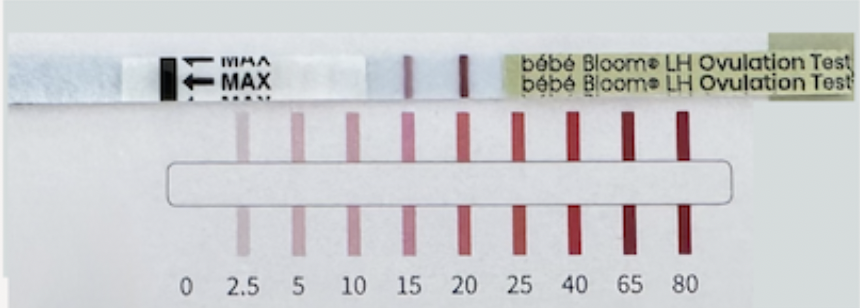
Match your Test Line to the closest colour on the card. That colour is your LH numerical value.
This is a less commonly known category, and the one where bébé bloom sits.
A semiquantitative ovulation test gives you a number that represents your LH level, rather than a positive or negative. Instead of telling you that your LH has crossed a threshold, it shows you where your LH actually is across a defined range.
The bébé bloom Ovulation Test measures LH from 0–80 mIU/mL. After testing, you match your Test Line colour to the Test Reader Colour Card (each colour corresponds to an LH value) and record the result on your LH Fluctuation Curve Chart. Over a cycle, you end up with a curve showing how your LH rises and falls, rather than a series of positive and negative days. And because you are matching a colour rather than judging whether a line is darker than yesterday's, the result is objective and repeatable.
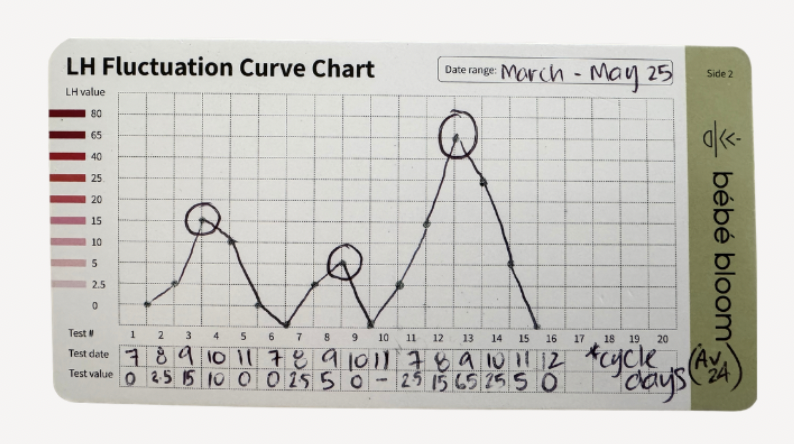
Three cycles, three different peak values. This is what understanding your pattern actually looks like.
Digital ovulation tests
Digital tests display a symbol rather than a line, typically a smiley face, or words like 'High' and 'Peak'. They are often easier to read at a glance, which reduces some of the anxiety around line interpretation.
What is worth knowing: most digital tests still use a qualitative detection method underneath. The digital display is a different interface, not a different test. You are still getting a positive or negative; it is just shown to you differently.
Some digital systems also detect oestrogen (E3G) in addition to LH, which allows them to identify a 'High' fertility window in the days before the LH surge, giving you a slightly longer window to act on. These tend to be more expensive.
What TGA registration actually means
In Australia, therapeutic devices, meaning products that make health claims, are regulated by the Therapeutic Goods Administration (TGA). To be listed on the Australian Register of Therapeutic Goods (ARTG), a product must meet standards for safety, quality, and performance.
The bébé bloom Ovulation Test is TGA-registered (ARTG 351757). This means it has been assessed against Australian regulatory requirements and is listed as a therapeutic device rather than a general wellness product.
Many ovulation tests available in Australia are not TGA-registered. This does not mean they do not work, but it does mean they have not gone through the same level of regulatory assessment. If that matters to you, and for something you are using to make decisions about trying to conceive it is reasonable for it to, TGA registration is worth checking.
So which type of ovulation test is most accurate?
A well-made standard strip will reliably detect an LH surge. The detection itself is accurate. The limitation is how much information it gives you.
A semiquantitative test gives you more information, and that information is useful at every stage. Even with regular cycles, knowing your peak LH value and how quickly your surge rises and falls gives you a personal baseline that a positive or negative result never could.
For women with irregular cycles or a history of confusing OPK results, that baseline becomes even more important. Tracking a number across your cycle gives you something to work with when a positive or negative alone does not tell the full story.
And if you want a test that meets Australian regulatory standards for a therapeutic device, TGA registration narrows your options considerably. The bébé bloom Ovulation Test is TGA-registered (ARTG 351757) and measures LH from 0–80 mIU/mL, giving you a numerical value rather than a threshold result.
A note on other fertility tests
Ovulation tests measure LH and are designed to detect the approach of ovulation. They are one part of fertility awareness, and a useful one, but not the whole picture.
Other at-home tests, like AMH (ovarian reserve) finger-prick kits, measure different things and serve different purposes. An AMH test tells you about your egg reserve. It is useful context for understanding your fertility broadly, but it will not tell you when you are ovulating.
If you are trying to conceive, an ovulation test is usually the most directly actionable place to start. If you have broader concerns about your fertility, a conversation with your GP is the right next step.

Tracking your cycle is one of the most empowering things you can do when you are trying to conceive. The more you understand your body, the more confident you can feel in the decisions you make along the way.
With love,
Fatima & Sara 💜
Founders of bébé bloom
Frequently asked questions
-
Some are, some are not. Ovulation tests that make therapeutic claims, such as helping to identify fertile days as part of trying to conceive, should be listed on the Australian Register of Therapeutic Goods (ARTG). The bébé bloom Ovulation Test is TGA-registered (ARTG 351757). If you are unsure about a test you are considering, you can search the ARTG at tga.gov.au.
-
A regular ovulation test gives you a positive or negative result based on whether your LH has crossed a preset threshold. A semiquantitative ovulation test gives you a numerical LH value across a defined range. The bébé bloom Ovulation Test measures LH from 0–80 mIU/mL, so you can see your hormone rising and falling across your cycle rather than waiting for a single positive result.
-
The bébé bloom Ovulation Test gives a numerical LH reading across a range of 0–80 mIU/mL. After testing, you match your Test Line colour to the Test Reader Colour Card included in your kit, where each colour corresponds to an LH numerical value, and record that number on your LH Fluctuation Curve Chart. It is TGA-registered in Australia (ARTG 351757).
-
Allow 5 to 10 minutes after testing before reading your result. Once 10 minutes have passed, the result is no longer considered accurate.
-
The bébé bloom Ovulation Test can be taken at any time of day, but testing between 10am and 10pm tends to give the most reliable results. Testing too early in the morning can give a falsely low reading as LH surges during daylight hours. Test at the same time each day for the most consistent comparison between results, and avoid large amounts of fluid for approximately two hours before testing.
-
Three things set it apart. It gives you an LH numerical value across a range of 0–80 mIU/mL rather than a positive or negative result, which means you can see your hormone rising in the days before your peak and get earlier insight into your approaching fertile window. Once your LH surge is detected, ovulation is likely within 24–36 hours — and fertility is highest on the day of detection and the day after, giving you a 48-hour window to act on. It is TGA-registered as a therapeutic device in Australia (ARTG 351757). And it uses over 90% less plastic than midstream ovulation tests.
-
When to start testing depends on your cycle length. For a 28-day cycle, the IFU recommends starting on Day 11. Refer to the When to Start Chart included in your kit to find your personal starting day. Test once daily until your Test Line begins to darken, then increase to two tests per day until you have clearly reached your peak and seen the value begin to fall.
Disclaimer: This content is for informational purposes only and does not constitute medical advice. If you have concerns about your fertility or cycle, please speak with your GP or a qualified health professional.
bébé bloom Ovulation Test is listed on the Australian Register of Therapeutic Goods (ARTG 351757).
Share this resource with someone who needs it. 💜
